
-
Products and Technology
By Category
-
Groups
Activity Groups
Industry Groups
Influence and Feedback Groups
Interest Groups
Location Groups
Customer Only Groups
- Developers
- Partners
- Events
- Help Center
- Topic Pages
-
Explore SAP
Products
- Autonomous Enterprise
- Artificial intelligence
- Data and analytics
- Autonomous Suite
- Technology platform
- Transformation management
- Midsize business solutions
- Financial management
- Spend management
- Supply chain management
- Human capital management
- Customer experience
- Enterprise resource planning
- Business network
- Sustainability management
- SAP Store
- Try SAP
- View all industries
- Partners
- Services
Learning and Support
-
- Products and Technology
- Groups
- Developers
- Partners
- Events
- Help Center
- Topic Pages
-
Explore SAP
- Explore SAP
-
Products
- Products
- Autonomous Enterprise
- Artificial intelligence
- Data and analytics
- Autonomous Suite
- Technology platform
- Transformation management
- Midsize business solutions
- Financial management
- Spend management
- Supply chain management
- Human capital management
- Customer experience
- Enterprise resource planning
- Business network
- Sustainability management
- SAP Store
- Try SAP
- View all industries
- Partners
- Services
- Learning and Support
- About

- SAP Community
- Products and Technology
- Additional Blog Posts by SAP
- New Web Dynpro Java Learning Material - Using Adap...

 BeGanz
- Subscribe to RSS Feed
- Mark as New
- Mark as Read
- Bookmark
- Subscribe
- Printer Friendly Page
- Report Inappropriate Content
- Tutorial: Creating an E-Mail Client Using Web Dynpro's Adaptive Web Service Model
- Article: Adaptive Web Service Model – Controller Coding Explained
- NEW: SDN Wiki Page: Web Dynpro Java FAQs - Models - Adaptive Web Service
Tutorial: Creating an E-Mail Client Using Web Dynpro's Adaptive Web Service Model

In this tutorial, you will develop a Web Dynpro application for sending an e-mail message, using an e-mail Web service provided by an external service provider. It fully describes all required development steps like setting up a new project, importing the Adaptive Web Service Model, defining context mapping and binding relations, designing the view layout and implementing the controller code.
Use of the e-mail Web service is enabled by an appropriate Adaptive Web Service model generated by the Web Dynpro tools. The quick implementation of this Web Dynpro application is characterized by a highly declarative development process, in which the required implementation workload can be reduced to a few lines of Java code.
-
Corresponding Tutorial: Creating an E–Mail Client Using Web Dynpro's Adaptive Web Service Model
- Code Sample: The ready-to-use project is available as a zip file here: TutWD_Email_AdWSModel.zip.
- Installation: SAP NetWeaver 2004s Java Trial Version, SAP NetWeaver 04 SP Stack 17, SAP NetWeaver 7.0 SP Stack 6
- Level of complexity: Intermediate
- Time required for completion: 1.5 hr.
Note: SAP AG cannot guarantee the availability of the third-party Web service used in this tutorial and does not assume any responsibility for the quality of this service.
Note 20/01/2010: Deleted links to tutorial resources, as the applied external Web Service is no longer available.
Article: Adaptive Web Service Model Controller Coding Explained
Note: This article is an addition to the tutorial Creating an E–Mail Client Using Web Dynpro's Adaptive Web Service Model above comprising an in-depth description of the coding-specific technical details. Please read the introductory tutorial first to understand the Adaptive Web Service Model principles. Both, tutorial and article, are based on the same Web Dynpro sample application.
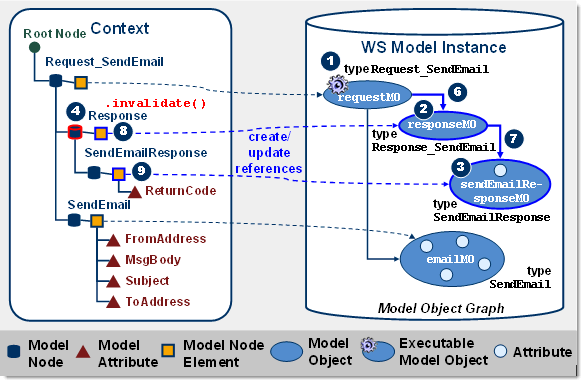
This article de-mystifies the magic relationship between a Web Dynpro model and a Web Dynpro controller context at runtime, so that you really understand how to correctly implement the model-specific controller code within your own Web Dynpro applications: how to instantiate model objects, how to create a model object graph, how to bind executable model objects to a context node, what’s going on technically when executing a model object and why to invoke the IWDNode.invalidate() method of the response context node object.
In addition to these principle aspects this article describes some technical details which are specific for the Adaptive Web Service Model like tracing Web Service invocations and programmatically modifying Web Service invocation settings with the IWDWSInvocationModifier-API and the Service Extenstion Interfaces of the Web Service Runtime.
- Corresponding Article: Adaptive Web Service Model – Controller Coding Explained
- Code Sample: The code sample is part of the ready-to-use project for the above Adaptive Email WS tutorial: TutWD_Email_AdWSModel.zip.
- Installation: SAP NetWeaver 2004s Java Trial Version, SAP NetWeaver 04 SP Stack 17, SAP NetWeaver 7.0 SP Stack 6
SDN Wiki Page: Web Dynpro Java FAQs - Models - Adaptive Web Service
The Adaptive Web Service Model topic is a perfect candidate for the SDN Wiki. I'm totally convinced that the collaborative Wiki approach yields many advantages for technical knowledge transfer compared to the former PDF- or WebLog-based approach: easy content editing, rapid update, code formating, collaborative editing, comment support, label/tagging support and much more Web 2.0 like features. Together with my colleague Patric Ksinsik I therefor created a specific SDN Wiki page comprising lots of in-depth information on the Adaptive Web Service Model:
FAQ - Models - Adaptive Web Service.
You are friendly invited to edit this wiki page, to add new FAQ entries, to improve or correct its content or to add comments to it using the comments tab.
Printing a SDN Wiki FAQ Page
To print a SDN wiki page you must simply select the context menu item Open Link in New Window above the Print icon in the top right corner. The page content is then rendered in a new window without additional navigation side bar, where you can apply your browser's print function.

Enjoy Web Dynpro,
Bertram Ganz, Web Dynpro Java Knowledge Transfer, SAP NetWeaver UI, SAP AG
 Bluesky
- You are the Voice of HR! Participate Now in Sapient Insights Group’s 29th Annual HR Systems Survey in Human Capital Management Blog Posts by SAP
- Modernizing Healthcare ERP Systems (SAP S/4HANA) to Strengthen Operations and Support Better Care in Technology Blog Posts by Members
- GRC Tuesdays: What's New in SAP Global Trade Services - Manage Origin of Goods in Financial Management Blog Posts by SAP
- Understanding SAP Supply Chain through Production, Procurement and Sales by AI Comics in Supply Chain Management Blog Posts by SAP
- Modern SAP Cloud ERP Security: From Core ERP to BTP, SaaS, and AI in Technology Blog Posts by SAP

