
-
Products and Technology
By Category
-
Groups
Activity Groups
Industry Groups
Influence and Feedback Groups
Interest Groups
Location Groups
Customer Only Groups
- Developers
- Partners
- Events
- Help Center
- Topic Pages
-
Explore SAP
Products
- Autonomous Enterprise
- Artificial intelligence
- Data and analytics
- Autonomous Suite
- Technology platform
- Transformation management
- Midsize business solutions
- Financial management
- Spend management
- Supply chain management
- Human capital management
- Customer experience
- Enterprise resource planning
- Business network
- Sustainability management
- SAP Store
- Try SAP
- View all industries
- Partners
- Services
Learning and Support
-
- Products and Technology
- Groups
- Developers
- Partners
- Events
- Help Center
- Topic Pages
-
Explore SAP
- Explore SAP
-
Products
- Products
- Autonomous Enterprise
- Artificial intelligence
- Data and analytics
- Autonomous Suite
- Technology platform
- Transformation management
- Midsize business solutions
- Financial management
- Spend management
- Supply chain management
- Human capital management
- Customer experience
- Enterprise resource planning
- Business network
- Sustainability management
- SAP Store
- Try SAP
- View all industries
- Partners
- Services
- Learning and Support
- About

- SAP Community
- Products and Technology
- Technology
- Technology Blog Posts by SAP
- DevOps with SAP BTP: Plan & Setup
Technology Blog Posts by SAP
Turn on suggestions
Auto-suggest helps you quickly narrow down your search results by suggesting possible matches as you type.
Showing results for
Success! Subscription added.
Read only

 BorisZarske
Product and Topic Expert
Options
- Subscribe to RSS Feed
- Mark as New
- Mark as Read
- Bookmark
- Subscribe
- Printer Friendly Page
- Report Inappropriate Content
2019 Dec 03
8:16 AM
5,007
After I have provided the overview of our portfolio of tools/services that help to foster DevOps principles and simplify adoption for cloud-native applications as well as hybrid scenarios in my previous article, I will offer more insights on especially the Plan & Set Up phase in this blog post.
Goal of this first phase of the overall approach outlined in the figure below is to decide on basic aspects around DevOps and lifecycle management and to set up required infrastructures and toolchains for applying DevOps principles efficiently for your apps to be developed and run with SAP BTP.
To plan your projects around SAP BTP, the Best Practices with SAP BTP guide explains basic platform concepts and provides guidance, such as for account structuring, development and delivery.
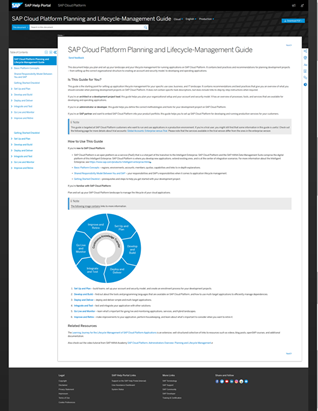
It is a good first read to learn about many operations aspects around SAP BTP.
Also, the guide provides guidance on account structuring, with many examples.
Another good entry point to get further information about the cloud platform offering and to gain first hands-on experience is the SAP Discovery Center, where SAP also offers many missions, for example to implement a business-specific scenario with ease or to set up and onboard some of our DevOps services on the platform.

A corner stone for development and test and increased agility and quality in a DevOps environment is Continuous Integration (CI) and Continuous Delivery (CD), the practice of integrating frequently into a common source code repository and then validating and testing implemented changes automatically – by using a CI/CD pipeline. Such a pipeline triggers involved tools and infrastructures – such as to initiate builds, trigger automated tests running on open source or third-party tools and deployments – and provides transparency on the outcome of pipeline runs.
To adopt CI/CD around development projects in SAP environments easily, there are several offerings:
Result of the Plan & Set Up phase should be a clear understanding of your overall DevOps approach and ideally a configured environment, including CI/CD infrastructure for your development projects (at least in a first version for build and test – then to be further extended and evolved as required).
Continue with Develop & Test, the next phase in your DevOps adoption journey with SAP BTP, where your development teams use the automated pipeline to come up with increments in the form of development and application content of high quality.
Goal of this first phase of the overall approach outlined in the figure below is to decide on basic aspects around DevOps and lifecycle management and to set up required infrastructures and toolchains for applying DevOps principles efficiently for your apps to be developed and run with SAP BTP.

Best Practices with SAP BTP Guide
To plan your projects around SAP BTP, the Best Practices with SAP BTP guide explains basic platform concepts and provides guidance, such as for account structuring, development and delivery.
It is a good first read to learn about many operations aspects around SAP BTP.
Also, the guide provides guidance on account structuring, with many examples.
SAP Discovery Center
Another good entry point to get further information about the cloud platform offering and to gain first hands-on experience is the SAP Discovery Center, where SAP also offers many missions, for example to implement a business-specific scenario with ease or to set up and onboard some of our DevOps services on the platform.
Continuous Integration and Delivery (CI/CD)
A corner stone for development and test and increased agility and quality in a DevOps environment is Continuous Integration (CI) and Continuous Delivery (CD), the practice of integrating frequently into a common source code repository and then validating and testing implemented changes automatically – by using a CI/CD pipeline. Such a pipeline triggers involved tools and infrastructures – such as to initiate builds, trigger automated tests running on open source or third-party tools and deployments – and provides transparency on the outcome of pipeline runs.
To adopt CI/CD around development projects in SAP environments easily, there are several offerings:
- If you want to configure and run automated pipelines without own CI/CD infrastructure and without the need for in-depth CI/CD knowledge, consider the SAP Continuous Integration and Delivery service. It allows you to jumpstart CI/CD processes especially around SAP-centric use cases, such as for SAPUI5 and Cloud Application Programming (CAP) model based projects.

- If you should have an own CI/CD infrastructure in place already or you should need more flexibility, Project “Piper” provides pre-configured pipelines and templates that you can use in your own CI/CD infrastructure and adapt according to your needs. For this, a library of steps is offered (that you can use to extend and adapt your pipeline) and a set of containerized tool images that you can download and add to your existing pipeline.

- If you should need full flexibility, the Continuous Integration and Delivery Best Practices Guide provides simple procedures to implement continuous delivery pipelines on any CI/CD stack and a basic understanding how to apply CI/CD principles to SAP-specific technology, with whatever CI/CD infrastructure you might have or plan to use.
Result
Result of the Plan & Set Up phase should be a clear understanding of your overall DevOps approach and ideally a configured environment, including CI/CD infrastructure for your development projects (at least in a first version for build and test – then to be further extended and evolved as required).
Continue with Develop & Test, the next phase in your DevOps adoption journey with SAP BTP, where your development teams use the automated pipeline to come up with increments in the form of development and application content of high quality.
Labels
2 Comments
You must be a registered user to add a comment. If you've already registered, sign in. Otherwise, register and sign in.
 Bluesky
Related Content
- Setting up Document Grounding for Joule with Google Drive in Technology Blog Posts by SAP
- Deploying SAP HANA 2.0 on AWS Using Terraform and Ansible in Technology Blog Posts by Members
- Integrating SAP BTP DMS with SAP Cloud ALM to upload external files in SAP Cloud ALM, using Boosters in Technology Blog Posts by Members
- Quality Inspection with POSC in SAP EWM in Technology Blog Posts by Members
- SAP Integration Suite - External logging to Datadog Using OpenTelemetry in Technology Blog Posts by Members
Top liked authors
| User | Count |
|---|---|
| 48 | |
| 47 | |
| 35 | |
| 33 | |
| 32 | |
| 29 | |
| 29 | |
| 24 | |
| 23 | |
| 22 |


